
There is plenty of debate about what a compact CNC mill can realistically handle. Instead of responding to speculation, Practical Machinist partnered with Tormach to put the Tormach 1500MX CNC mill through a structured, real world cutting evaluation. The goal was simple: document how the machine performs across a broad range of materials using consistent tooling, workholding, and test parameters.
Seven materials were selected for the test: 6061 aluminum, 1018 carbon steel, 303 stainless steel, 4140 alloy steel, Inconel 625, 6Al-4V titanium, and Hastelloy C22. By holding key variables constant and adjusting only speeds, feeds, and stepovers, the team evaluated both adaptive toolpaths and heavier engagement cuts to better understand spindle load, stability, and overall cutting performance.
A Controlled Cutting Test Setup
The experiment was structured much like a science project. A consistent tool diameter of 3/8 in. was used throughout. Five identical five flute carbide end mills were reserved for the hardest materials. Additional 3/8 in. tools were used for aluminum and 1018 steel. Workholding remained unchanged for each test, and every material was cut to a half inch depth.
The primary variables were speeds, feeds, and stepovers. The initial phase used adaptive toolpaths at approximately five percent radial engagement. This approach reduces tool pressure while maintaining high spindle speeds and feed rates. After adaptive roughing, each material was subjected to a heavier stepover pass, described as the torture test, to evaluate spindle load and stability under higher cutting forces.
The test geometry was a dog bone profile. This shape was selected to evaluate how the machine handles radiused transitions and to observe whether chatter or faceting appears on curved surfaces.
Aluminum and Carbon Steel Performance On The 1500MX
The first material, 6061 aluminum, was cut using adaptive toolpaths and then pushed further during the heavier pass. Spindle load peaked well below the machine’s maximum capacity, and the finished part showed smooth radii with no visible chatter.
Moving to 1018 carbon steel, the machine maintained stable spindle load during adaptive cutting. During heavier engagement, spindle load increased but remained manageable. The resulting surface quality showed clean radii with no visible deflection marks. Tool life remained intact through the full operation.
Stainless and Alloy Steel Under Load On the 1500MX
The 303 stainless steel test on the 1500MX introduced higher resistance. During adaptive passes, spindle load hovered at moderate levels. When stepover increased toward roughly half engagement, the spindle motor protection activated after load climbed into the upper range. The system shut down both spindle and axis motion simultaneously, demonstrating built in protection against overload.
After reducing stepover and allowing the spindle to cool, the operation resumed successfully. With adjusted parameters, the machine completed the cut and delivered a consistent wall finish.
The 4140 alloy steel test followed a similar structure. Adaptive passes stayed within reasonable load levels. During heavier engagement, spindle load increased significantly but remained under the maximum threshold. The final surface showed clean transitions and stable cutting throughout the radii.
The 1500MX Takes on Superalloys and Titanium
The test then moved into less familiar territory with Inconel 625, 6Al-4V titanium, and Hastelloy C22. For Inconel, adaptive cutting remained stable at moderate spindle load. During heavier engagement, load approached higher levels and required a reduction in stepover. Once adjusted, the machine completed the operation and maintained consistent wall finish.
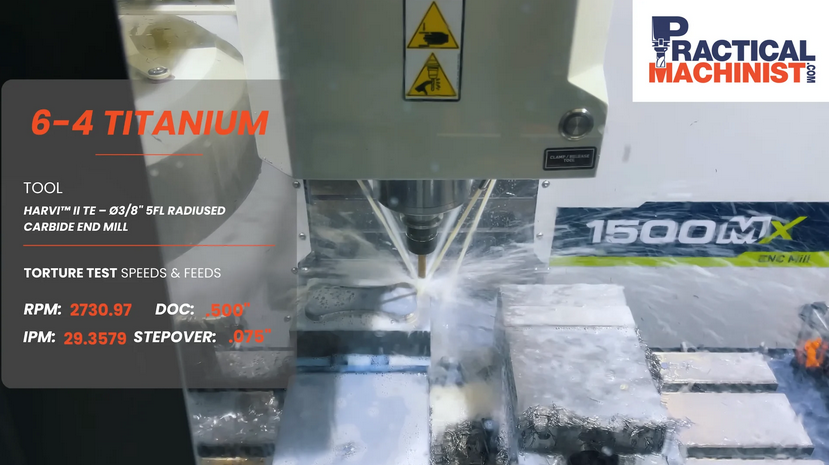
Titanium presented a different profile. Adaptive cutting ran at moderate load, and the heavier stepover pass stayed within manageable levels. Despite this being a first time cutting titanium in this setup, the results showed smooth transitions and stable tool performance.
Hastelloy C22 required a modified part model to keep cycle time reasonable. Even with reduced engagement, the material required extended machining time. Spindle load remained surprisingly low during much of the cut, and the final surface showed consistent wall finish with intact tooling.
What the Results Show
Across seven materials ranging from aluminum to nickel based superalloys, the Tormach 1500MX demonstrated stable operation, effective overload protection, and the ability to complete challenging cuts when speeds and feeds were properly adjusted. While heavier stepovers sometimes required parameter changes, the machine handled each material without catastrophic failure or tool breakage.
The test reinforces an important takeaway. Material capability is not defined solely by machine size. With appropriate tooling, correct programming, and realistic strategies, compact CNC mills can successfully cut a broad range of materials that many assume are out of reach.